how about this

A blog of Nineteenth Century history, focusing, but not exclusively, on the American Civil War seen through the prism of personal accounts, newspaper stories, administrative records and global history.
A thousand tales. A miscellany. A maze of historical tangents.

A Capitol View

A Capitol View
Images of 1861 juxtaposed- Union Square, New York vs. Capitol Square, Richmond
Showing posts with label Col. Robert M. West. Show all posts

Saturday, May 17, 2014

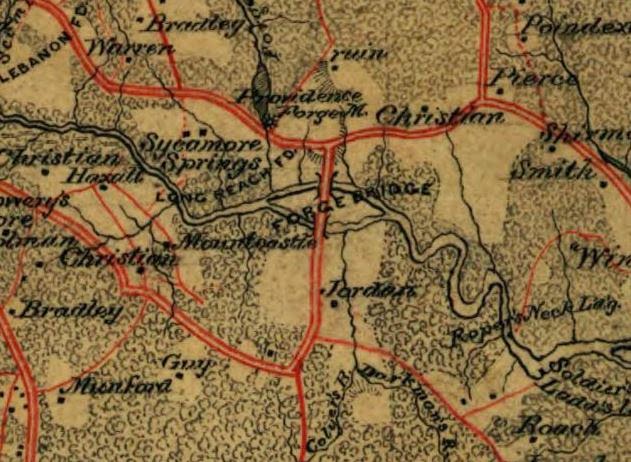
Action at Jones' Bridge(Providence Forge)- The First United States Colored Cavalry


Gilmer map from VHS collection

 Wherein Frederick W. Browne describes how the 1st United States Colored Cavalry took Jones' Bridge .  . . . twice.

MY SERVICE IN THE U. S. COLORED CAVALRY
Having served over two years in a good, hard-fighting infantry regiment, and being encamped at Newport News, Va., holding the dignified rank of Sergeant, I one day met our little fighting Major John G. Chambers who asked me if I would like a commission in the 1st U. S. Colored Cavalry, then forming at Fort Monroe, to which I made answer that I would, and two or three days thereafter I received an order, mustering me out of the service and also an order to report to Colonel Garrard for duty as an officer of the new regiment. Early the next morning, going down to the wharf to embark for Ft. Monroe, I showed to the sentry on the wharf (as my authority for leaving) the order mustering me out. He looked it over and said in a home-sick way, “I would give $800 for that paper.” I reported to Colonel Garrard, and for the first time saw this officer with whose reputation as a brave and efficient Major of the 3d N. Y. Cavalry I had been well acquainted in the Department of North Carolina. This regiment, being the first colored cavalry regiment, had in its ranks a rather better class of men than the infantry regiments had; some being from the North and some being the outlaw negroes who, in slavery times, had been able to maintain their liberty in the swamps of Eastern Virginia and North Carolina. The regiment was officered largely from the 3d N. Y. Cavalry, and they were a thoroughly efficient and capable corps of officers. The regiment was soon filled, mounted and equipped, and constant drill soon made it have the manner and bearing of soldiers. Every one knew that the Campaign of 1864 meant business, and therefore all was in readiness when about May 1st orders came to move. We marched out through Hampton, of which not one house was left except the little old stone church which is still standing there. Through Big Bethel, the scene of one of the earliest disasters of the war, to Yorktown, memorable for its two sieges in two wars, and thence on to Williamsburg, passing between Yorktown and Williamsburg our infantry who, much to our surprise were marching very hurriedly back to Yorktown. We learned afterward they were put on board transports at Yorktown and sent up the James to City Point and Bermuda Hundred. The next day we went up the Peninsula, passing 6 and 12 Mile and burnt ordinarys, camping at night at New Kent Court House. I commanded the picket that night on the Bottoms Bridge Road and the enemy’s scouts were against us all night, keeping matters well stirred up. The next morning we turned South and met the enemy at Jones Ford on the Chickahominy. They were in an earthwork across the Ford and we opened on them with our howitzers in front and deployed as to cross in front, but a force was sent to the right up stream who managed to cross, and, coming down on the opposite side of the river, took the enemy in flank and soon drove them away from the ford. Killing some and capturing some of the enemy, and having some killed and wounded, our movement having been a feint to make the enemy believe that Butler’s Army of the James, as it was afterward called, was moving up the Peninsula, having been accomplished, we returned to Williamsburg, arriving there the next day, where, to our astonishment, we met an order to go back at once and cross the Chickahominy at Jones Ford, sometimes called Jones Bridge, and proceed to Harrison’s Landing, which we at once did, again fighting our way across at Jones Ford. Steamers were lying at the wharf in front of the old Westover mansion, and, going on board, we were soon thereafter landed at Bermuda Hundred and passing out took the advance of Butler’s Army, being at the time the only cavalry he had.

-My Service in the United States Colored Cavalry
Paper of Frederick W. Browne, Second Lieut. 1st U.S. Colored Cavalry
of Cincinnati, Ohio,
Read before The Ohio Commandery of The Loyal Legion,
March 4, 1908.


MOLLUS Massachusetts Civil War Photographs- USAHEC

 The (unfortunately watermarked) photograph of Col. Jeptha Garrard, commander of the First USCT Cavalry.

 -This is a cross posting from New Kent County History.

Monday, April 28, 2014

"In the Long Woods"- 150 Years Ago


Wistar and staff, photo from the HR History site of the Daily Press

Expedition from Williamsburg and skirmish at Twelve-Mile Ordinary, Va.

Report of Col. Benjamin F. Onderdonk, First New York Mounted Rifles.

                                 HEADQUARTERS FIRST MOUNTED RIFLES,
                                     Near Williamsburg, Va., April 29, 1864.
COLONEL: I have the honor to report, pursuant to orders of the 27th instant, I marched at an early hour. Nothing of importance occurred until we reached the long woods beyond Twelve-Mile Ordinary, where we were fired on by scouts, one of whom (Davis) we captured. The next picket, near Slatersville, we charged to New Kent, capturing 3. The most reliable information I could gain was that there is no force at Tunstall's Station, on the Pamunkey. I could get no information. At Bottoms Bridge are 2,000 infantry and artillery, with Holcombe's battalion of cavalry. Nine field guns are constantly on duty. All the public fords on the river above Fords Bridge are blockaded and heavily guarded. A large force is stationed at a central point, from which re-enforcements can be thrown to any point above New Bridge in half an hour. Fifteen thousand can be brought to the defense of Bottoms Bridge in that time. Fords Bridge Ford, three days since, was only defended by a small picket. There is also a picket at Charles City Court-House. The camp of this force performing this duty (supposed to be the Forty-second Battalion) is 6 miles from the court-house, toward Richmond. At the latter place the people are in great excitement. The enemy are strengthening fortifications, and troops are constantly arriving from the direction of Charleston. I believe the Charles City Court-House road is the least defended. There is no force this side of Bottoms Bridge except one troop of the Holcombe Cavalry, at Cedar Hill, 2 miles beyond New Kent Court-House, to picket the roads, but they retreat at the shortest notice. We reached New Ken Court-House at 12.45; rested an hour and a half; returned to Barhamsville, where we halted two hours to feed and supper. Finding the horses very fresh, I decided to return.
In the long woods, 1 mile beyond Twelve-Mile Ordinary, we were attacked at 9 o'clock by an ambuscade (supposed to be the Peninsula Scouts); they had scattered torpedoes or shells, with friction fuses, in the road, six of which exploded in my column, the fire of the fuses making. a strong light, of which the enemy took advantage to fire on the men. I wheeled into line, and gave the enemy a volley, which caused them to leave, but they returned again and kept up a continuous fusilade on my entire column as it passed. I did not deem it advisable to follow them into the woods, as I had reason to suppose their infernal machines might do me more injury than the random fire. Although the shells exploded in the midst of the horses and men, strange to say but one man and two horses were slightly wounded with pieces of shell. My men behaved as coolly as on parade, although the uncommon style of warfare was sufficient to destroy the equanimity of the best troops. I should judge the machines to be about 20-pounder shells; they seemed to be charged with canister. Major Hamilton deserves particular notice for his coolness and gallantry through the entire trip. My thanks are due Maj. James N. Wheelan for volunteering to lead a small party around from Barhamsville to cut off the picket at New Kent Court-House, which only failed on account of the bad road, causing him to be half an hour late. I returned to camp 12.30 this morning.
Casualties: Corporal Feiling, Troop B, wounded in shoulder by shell (slightly).
I am, colonel, very respectfully, your obedient servant,
                                        B. F. ONDERDONK,
                          Colonel, Commanding Mounted Rifles.

Col. ROBERT M. WEST,
             Commanding Post.


                                                             [Indorsement.]

                                  HEADQUARTERS SECOND DIVISION,
                                                      April 29, 1864.
Respectfully forwarded.
 I further learn from deserters and prisoners (of which latter 4 were captured and sent down this morning) that there is a regiment of infantry (Fifty-third Virginia*) at White House; an accession of cavalry near Charles City Court-House; twenty pieces light artillery, both of brass and iron, at Bottoms Bridge, & c.; also that a wagon-load of torpedoes came down from Richmond four days since, in charge of Hume's Peninsula Scouts, for use on the Peninsula. road. They are not self-acting, but are discharged by cords attached, and managed by men concealed in the woods. The commanding general can infer from the above and the inclosed how far the enemy are expecting our advance by the Peninsula.
                                                    I. J. WISTAR,
                                                        Brigadier- General.


-The war of the rebellion: a compilation of the official records of the Union and Confederate armies.; Series 1- Volume 33


The Fifty-third Virginia Infantry* regiment had local components, the Pamunkey Rifles(Co. B), the Barhamsville Grays(Co. E) and the Charles City Southern Guards (Co. K).

Twelve-Mile Ordinary would be in the general location of what is now called Anderson's Corner, at the intersection of Routes 30 (New Kent Highway) and 60 (Richmond Road), to the west of Toano, Virginia.


COMING UP- General Wistar and "unamiable firmness" . . .